Notice the last tip says to "Get Gaming." One of the activities I do enjoy is gaming. Sometimes, it may not seem like it to those around me because I'm such an introvert (INTP/J; ISTP).
Admittedly, I sometimes get "peopled out," to quote my also-introverted-but-less-so hubby. Oh, I love people -- getting to know them and their stories. I enjoy playing games, especially ones with lots of strategy and not so much chance (chance = roll of the dice or card draw determines your fate). Yet, to recharge my battery, solitude is precious. And, I'm much more comfortable in small groups than in a room full of people.
Also, when I'm experiencing some brain-control issues or "Cog Fog" (those with MS know what I mean), I feel badly for taking so much time to think through things or playing poorly (if it is a cooperative/partner game). So, sometimes, I decline playing with others just so I don't put them through my snail's pace decision-making or cause them to lose by doing something "not so bright." [chuckle] Then, I choose solitary games or brain-strengthening tasks for myself.
Right now, we are on vacation. We've stopped along the way to spend time with some fellow gamers. I'm liking each person here and want to get to know each one better. You get this Darling Dozen in a room, and there are some good times going on! Plus, they adapt well to my showing up for a couple games, then running to seclusion again. I think they're keepers!

What I've played so far here: (click on each image to learn more about the game)
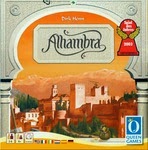 -- Alhambra: So far, this is my favorite of those played here and that were new to me. There's far more strategy in this tile-placement game than I'd figured there would be. Thought process while playing --> "Do I pick up more money so I can purchase that building so I can have more of that kind of structure in my city so I can earn points? Is that building going to get picked up by a competitor before I have a chance to purchase it? What color of money was he picking up? That'd give me a clue on what he is eyeing for the future of his city. Do I bother wasting a turn to reorganize my city to accommodate that building I have saved? Should I purchase that one just to keep it out of her hands, even though it'll likely not fit in my city? I wonder if we're almost out of tiles in the bag. I wonder if we're close to turning over one of the scoring cards." Decisions, decisions.
 -- Maori: Another I hadn't played before. Simple but fun! It plays quickly. There's some strategy. Good for young kids as well as adults. Build islands, trying not to leave blank spaces in your sea. You want trees, leis, huts, boats. You want it all. Can you have it all? What if someone gets the boat to a tile you wanted before you can get there? What if there's a volcano blocking the way?
 -- Ubongo 3D: New to me. If you think visually and like puzzles, you'll probably like this one. You get a card with a shape. You roll the die to see what blocks you get to use. You get a couple minutes on the timer. Now, build...no gaps, only 2 stories high, and the base cannot go beyond the pattern on the card but it must also fill it. There's honestly a solution. It's like Tetris has jumped out of the electronic screen right into your hot, little hands. It takes a while to get used to it, but I can see how it'd be addictive.
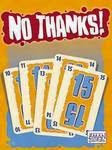 -- No Thanks!: Card game that was new to me. Simple, but there's strategy. You'll need some math skills to know what you are scoring along the way. You want a low score. A card gets flipped off the deck. If you want it, grab it. If you don't, throw one of your limited chips on it and say, "No thanks!" Chips count as -1, so you want those. If there's a card out there with a high number but lots of chips on it because everybody before you hasn't wanted it, perhaps it is worth picking up. If you can grab cards in number sequence, you only have to count the lowest number in that sequence. Game's over when cards are gone. Add the numbers on the cards you grabbed, subtract the chips. Lowest count wins. I like most games. I'm not raving about it, but I liked the strategy of it. Played it late at night, and my brain was running on fumes; so, another player graciously counted mine for me. [high five]
 -- Ricochet Robots: New to me. People think I didn't like this one because I said it was torturous. (chuckle) Frankly, that night, it was a bit maddening, but I think I would really like the game on a normal day. This game goes right along with how my brain is wired, but when it isn't firing on all pistons...well, it was humorous and a bit chaotic to watch what was going on between my ears. You have to figure out a path through the maze for one color of robot to get to its destination (based on a chip that comes up). You can move other robots to help "bounce" the right robot to its end location. Bid on how many moves you've figured out you can take to make it happen. Lowest bid tries first. If it didn't work out in that exact amount of moves you'd bid, then next lowest bid tries. You get the chip if your bid matches the number of moves it took you to get the robot to where it should go. Whoever has the most chips at the end wins.
You'd think there wouldn't be a lot of replay value in this game, but there is because where all the robots ended up at the last turn is where they start the next. Plus, the instruction chips (which color robot is to head where) come up in random order each time.
Why was this first time playing so nutty for me? By the time I silently figured out in my head about 9 moves, I'd forget them as I went on into thinking about the remaining moves needed. Start over. Forget. Start over. Forget. [RED ALERT: Malfunction in the echo-location and short-term memory modules! Unable to compute! ABORT!] I'm obsessed now, though. I will conquer this game!
 -- I've played this one before, and it is one of my favorites because there's no chance to this one. It is a purely strategic game. It had been a long time since I played it, so I'd forgotten just how much I like it. You build buildings, produce goods, and ship them off or sell them. Earn the most victory points, and you've got the game won. Simple enough, but choose wisely what to do when. It makes a difference. Take turns starting the round. You may not get to do the task you wanted to do this round, but maybe there's a 2nd best idea. Maybe you need to save up that task to do next round anyway. Think about what is in the best interest for others to do on their turn. Do you thwart their efforts, or do you not worry about it and concentrate on your own little enterprise? Where's the balance? If you're not paying attention to what's going on for other people, the game might just end before you've done your "big move." I've played a lot of games, and I'd say this is in my top 20 for board games.